PIM vs ERP: which system owns product data?
By Philipp Kant 4 min read
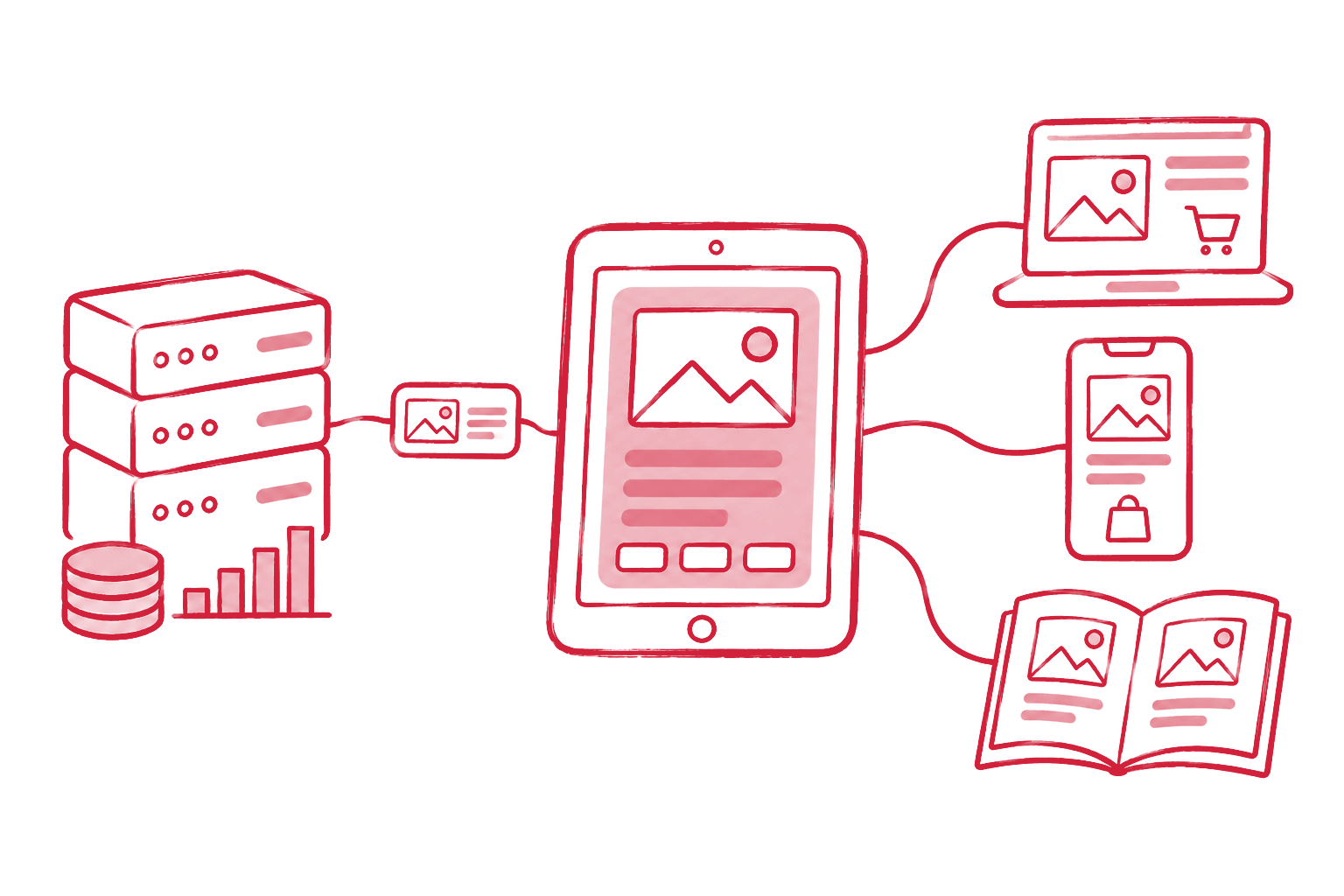
An ERP (enterprise resource planning) system runs a company’s business transactions: purchasing, warehouse, orders, invoices, accounting. A PIM (product information management) system maintains product information for sales: copy, attributes, images, and translations, prepared for the shop, marketplaces, and catalog. Both hold product data, but not the same data.
The short answer: the ERP owns what moves money and goods. The PIM owns what sells a product.
The comparison at a glance
| Criterion | ERP | PIM |
|---|---|---|
| Purpose | Run business transactions | Sell products in every channel |
| Owns | Item number, price, stock, purchasing, tax | Copy, attributes, images, categories, translations |
| Users | Purchasing, warehouse, accounting, inside sales | Product management, marketing, e-commerce |
| Data model | Fixed, built around processes | Flexible, attributes per product family |
| Variants and languages | Limited, often free text | Core of the software |
| Channels | Usually one, through an interface | Many: shop, marketplaces, print, dealers |
| Typical systems | SAP, Microsoft Dynamics, JTL, weclapp, Xentral, Odoo | Akeneo, Pimcore, Plytix, Salsify |
What the ERP does with product data
In the ERP, a product is an item to calculate with: item number, unit, purchase and sales price, tax rate, supplier, stock, storage location. The ERP knows what an item costs and how many are on hand. It is built for transactions: order, store, sell, invoice.
It is not built for sales copy. Description fields usually exist, but only a few, without structure per product family, without clean language variants, and without an approval flow. Whoever feeds a shop and two marketplaces from it ends up maintaining copy in spreadsheets and pasting.
What a PIM does better
A PIM is built for one question: what information does this product need in this channel, in this language? It groups attributes by product family (a ball valve has pressure rating and connection, a T-shirt size and material), shows how complete a product is per channel, manages images and documents, and gives every channel its own format.
What a PIM does not do: track stock, calculate prices, book orders. It does not replace the ERP; it is the layer between ERP and sales.
Which system owns which field
The most common mistake in PIM projects is a field maintained in both systems. Every field needs exactly one owning system:
| Field | Owner | Flows to |
|---|---|---|
| Item number, EAN | ERP | PIM, channels |
| Price, tax rate | ERP | Shop, marketplaces |
| Stock, delivery time | ERP | Shop, marketplaces |
| Product name, description | PIM | Channels |
| Technical attributes | PIM | Channels, catalog |
| Images, data sheets | PIM or DAM | Channels |
| Translations | PIM | Channels |
| Categories per channel | PIM | Channels |
The interface creates new items in the ERP and sends them to the PIM. There, product management enriches them, and the PIM releases them to the channels. Prices and stock go straight from the ERP to shop and marketplaces.
PIM, MDM, and DAM: where each ends
| System | Takes care of |
|---|---|
| PIM | Product information for sales |
| MDM | All master data: products, customers, suppliers, locations, across systems |
| DAM | Images, videos, documents, and their rights |
PIM is the part of master data management that focuses on products. Explained in detail in what MDM and PIM actually solve.
When an ERP alone is enough
| Your situation | ERP alone | ERP and PIM |
|---|---|---|
| Under a few hundred products, one language | Yes | Not needed |
| One shop connected directly to the ERP | Often yes | When the copy suffers |
| Several shops or marketplaces | Bottleneck | Yes |
| Several languages or countries | Bottleneck | Yes |
| Dealers who need your data in their format | No | Yes |
| Many attributes per product, shop filters | Difficult | Yes |
Which systems qualify is compared in Akeneo vs Pimcore. What goes wrong when migrating from ERP and spreadsheets is in the PIM migration checklist.
Head to head: the best PIM software systems and Odoo vs SAP Business One. Where the ERP ends and the sales system begins: CRM vs ERP.
FAQ
Do I need a PIM if I have an ERP? Not always. With few products, one language, and one channel, the ERP is enough. From several channels or languages on, a PIM saves more work than it costs.
Can an ERP module replace the PIM? Some ERP vendors offer PIM modules. They cover simple cases; for many attributes, channels, and languages they usually lack the flexibility of a dedicated PIM.
Who maintains the data when we have both? Purchasing and logistics in the ERP, product management and marketing in the PIM. The rule of which system owns which field belongs on paper before the project starts.
How good is our product data today? The free product data check shows it on an export from your system. We deliver PIM implementation and product data migration at a fixed price, connected to your ERP.
Ask an AI about this post
