PIM implementation and product data migration.
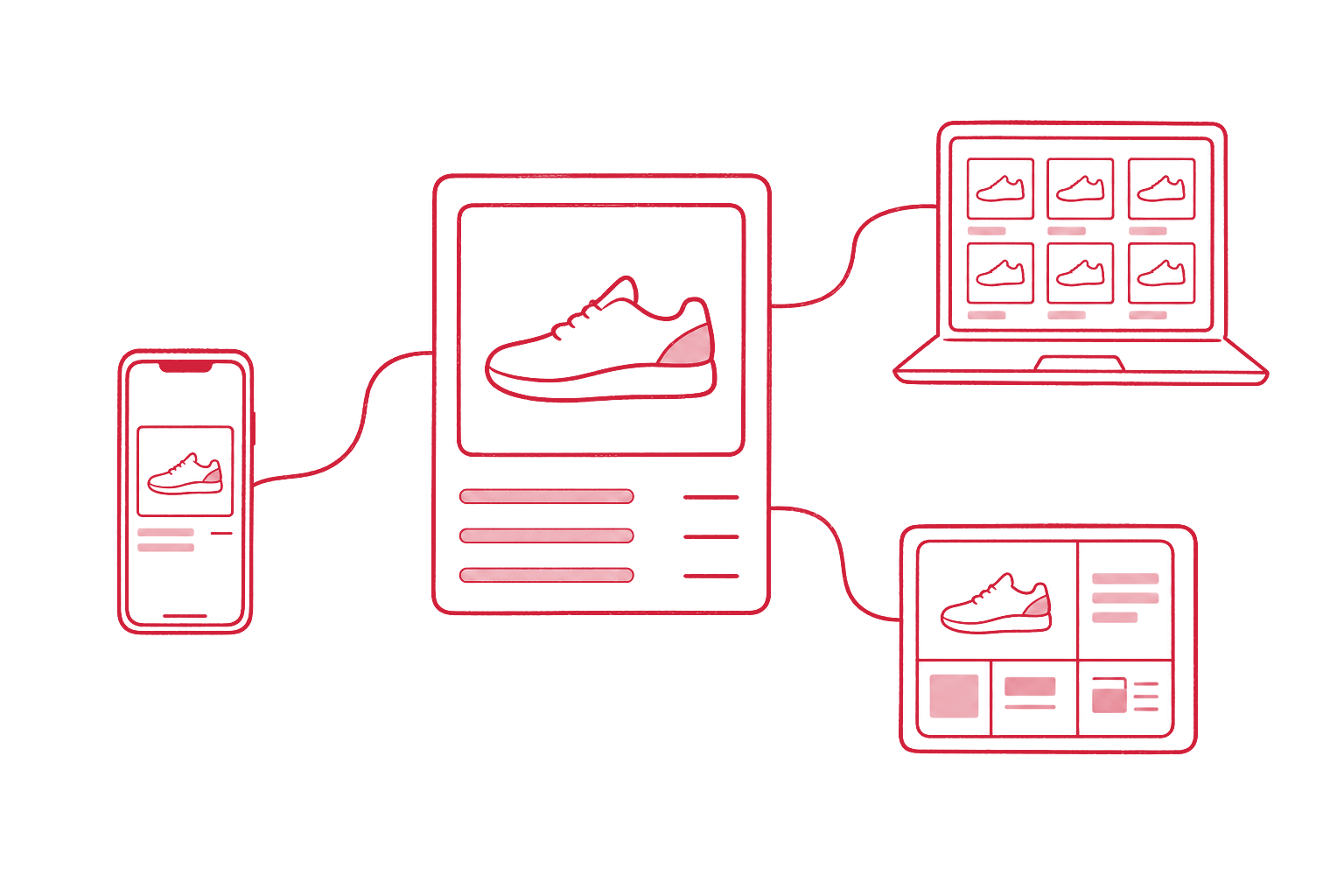
We implement PIM systems and migrate product data out of legacy systems: modeled, cleaned, and published from one governed source for shop, marketplaces, and print. Master data management (MDM) joins in once products, suppliers, and customers live in several systems.
Live demo
Watch an AI agent at work.
A supplier invoice arrives by email. The agent does the rest: through the interfaces of the ERP and PIM, and where there is none, it clicks through the program like a person.
Sample with invented data. This is how the agents we build into ERP, PIM, and CRM work.
This workflow for your companyHow the demo runs: a supplier invoice arrives by email. The AI agent reads the amount, due date, and items from the PDF. In the ERP it books the invoice through the interface, without a single click. In the PIM it updates the purchase price, also through the interface. The tax adviser's portal has no interface: the agent opens it, uploads the receipt, and fills in the fields like a person. Before submitting, it waits for the team's approval.
What we build with.
- PIM
- The PIM that fits your data model, for example Akeneo, Pimcore, or the PIM module of your ERP
- Sources
- Legacy databases, ERP, Excel and CSV files, supplier data
- Channels
- Shop, marketplaces, Google Shopping, print, and Adobe InDesign
- Quality
- Attribute model, taxonomy, validation rules, automated checks
How we start.
-

Write to us
Two or three sentences about the workflow. We reply personally and suggest a short call if it helps.
-

Proposal
A fixed-scope plan with timeline, price, deliverables, and open assumptions.
-

Build & handover
We run the build, ship the system, and hand over the operating model.
Pricing and deliverables.
The scope below prices the data work that makes a PIM useful: modeling, cleanup, migration, and channel output.
Pricing
€15k to €90k
- Timeline
- 6 to 18 weeks
- Scope
- Migration complexity drives the final fixed scope.
What's included
- Product and master-data audit
- Source-of-truth map across current systems
- Attribute model, taxonomy, and validation rules
- Legacy data mapping, cleanup, and migration path
- Channel exports for shop, marketplace, print, or InDesign
Add-ons
- Product Data Check cleanup sprint €1.5k
- InDesign export automation from €3.5k
- Translation and channel model from €2.5k
Questions on cost, time, and delivery.
What does a PIM implementation cost?
€15k to €90k, as a fixed price. The migration sets the price, not the PIM: how many sources there are, how clean the legacy data is, and how many channels the PIM feeds. PIM license fees come on top and depend on the vendor.
How long does a PIM implementation take?
6 to 18 weeks, depending on the number of sources and channels.
Which PIM system fits us?
Your data model decides: how many variants and attributes, how many languages and channels, and which system holds the truth today. We recommend a system after the data audit, not before it.
Do we need a PIM at all?
Not every company does. A PIM pays off once the same product data is maintained for several channels and errors cost money. For a shop with a few hundred products, the shop system is often enough.
What happens to our legacy data?
It gets mapped, cleaned, and checked against rules before it enters the PIM. Attributes that meant different things in different parts of the old schema get one meaning. That is how the ABT Sportsline migration ran: complex vehicle and parts data out of an old product database into a modern PIM.
What does AI have to do with product data?
AI shopping assistants and agents read product data as data. Missing attributes and contradicting values make products invisible to them. A PIM with a clean data model is the base; an agent then finds gaps and writes copy from the attributes.
Try it on your own data.
Free, no signup. Each one is a slice of this service, scoped down to a single job.
