n8n vs Make vs Zapier for AI agents
By Philipp Kant 4 min read
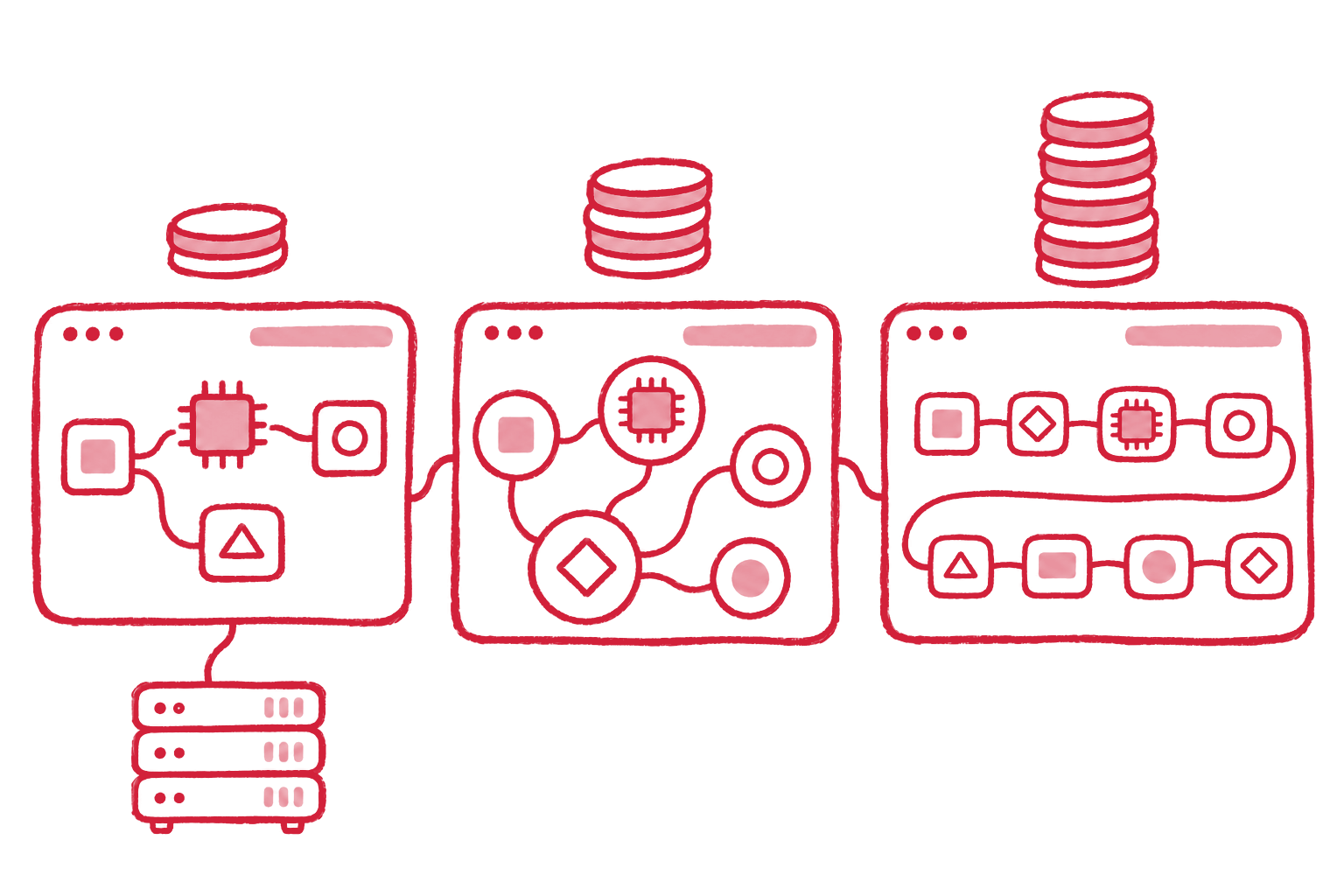
n8n, Make, and Zapier are workflow automation platforms: they connect applications through ready-made building blocks, without programming every connection. All three now offer building blocks for AI agents. They differ mainly in how they bill, where the data lives, and how much control you have over the agent.
Prices as of November 8, 2026, from the vendors’ pricing pages. Prices change often; check the current page before you decide.
The comparison at a glance
| n8n | Make | Zapier | |
|---|---|---|---|
| Billed by | Executions: one run of a workflow | Credits: usually one per action | Tasks: one per successful action step |
| Entry (cloud) | Starter €20 a month, 2,500 executions (annual) | Free with 1,000 credits; Core around $9 to $11 for 10,000 credits per third-party sources | Professional $19.99 a month, 750 tasks (annual) |
| Self-hosting | Yes, Community Edition on GitHub | No | No |
| Vendor based in | Berlin | Prague, owned by Celonis | USA |
| AI agents | Agent node with tools and memory | AI Agents and the Maia assistant | Zapier Agents, billed separately by activities |
| Strength | Volume, control, custom code inside workflows | Visual scenarios, cheap for many steps | The most ready-made app connections |
How the three bill
This is where the bills drift apart. Take a workflow with ten steps that runs 1,000 times a month:
- Zapier counts every successful action step as a task. Triggers and built-in tools such as Filter and Formatter do not count. With nine actions that is 9,000 tasks. A call to an MCP tool through Zapier costs two tasks.
- Make counts credits. Most actions cost one credit; features using Make’s own AI provider can cost more. Routers and error handlers do not count. That is roughly 9,000 to 10,000 credits.
- n8n counts one execution per run, regardless of the number of steps. That is 1,000 executions, or none at all when self-hosted.
For processes with many steps and high volume, n8n is almost always the cheapest. For a few short Zaps, Zapier can be enough.
AI agents on the three platforms
All three have agent building blocks: a model gets tools, meaning other steps or applications, and decides for itself which to use.
- n8n ships an agent node with tools, memory, and connections to the major models. Because n8n can be self-hosted, data and logs stay in your own network.
- Make offers AI Agents and the Maia assistant, which helps build scenarios.
- Zapier bills its Agents separately, by activities: 400 a month free, 1,500 on the Pro tier from about $33 a month on annual billing.
For simple agents, say “read an email, classify it, file it in the right inbox”, any of the three will do.
Data protection and GDPR
For companies in the EU the question is often: where does the data live?
- n8n can run on your own servers or in a German cloud. Then only the data you deliberately send to a model leaves your network.
- Make is a European vendor and runs data centers in the EU.
- Zapier is a US vendor. For personal data you need the data processing agreement and a review of the transfer to the US.
Whatever the platform: what goes to a language model goes to its provider. That belongs in the privacy review just as much as the platform itself.
When code beats every platform
Workflow platforms are strong as a backbone: triggers, fixed steps, connections. For agents at the core of a business process they hit limits:
- Approvals as a fixed rule: “postings only after approval” should be a rule the agent cannot get around, not an instruction in the prompt.
- Permissions per tool: read in the ERP yes, write only through a checked path.
- Tests: an agent that creates orders needs test cases that run on every change.
- Logging: every step, every input, every result, queryable.
That is why we usually build an agent’s harness in code and let the platform do the rest. What a harness is: What is an agent harness?. When an agent is needed at all: AI agent, RPA, or workflow.
Which platform when
- n8n when volume, cost, or data location matter, and someone on the team can look after a server.
- Make when business teams should build themselves, visually and cheaply.
- Zapier when it has to be quick, runs are few, and a rare app needs connecting.
- Code when an agent touches money, customers, or master data.
FAQ
Is n8n free? The Community Edition for self-hosting is on GitHub and has no license fee. You pay for the server and its upkeep. The cloud starts at €20 a month on annual billing.
Can I move from Zapier to n8n? Yes, but there is no export n8n can read. The workflows are rebuilt. With many Zaps it pays to clean up along the way.
Which platform has the most integrations? Zapier. For the systems German mid-sized companies run (SAP, DATEV, Shopware, JTL, Weclapp), check whether the integration really does what you need. Calling the API directly is often the sturdier route.
Do we need a platform for AI agents at all? No. For a single process, a lean program can be simpler. A platform pays off when many processes are maintained by several people.
Which processes pay off for you shows in the free KI-Potenzial-Check. For business process automation with AI, we build the right mix of platform and agent, at a fixed price.
Ask an AI about this post
