AI agent glossary: 20 terms in plain words
By Philipp Kant 4 min read
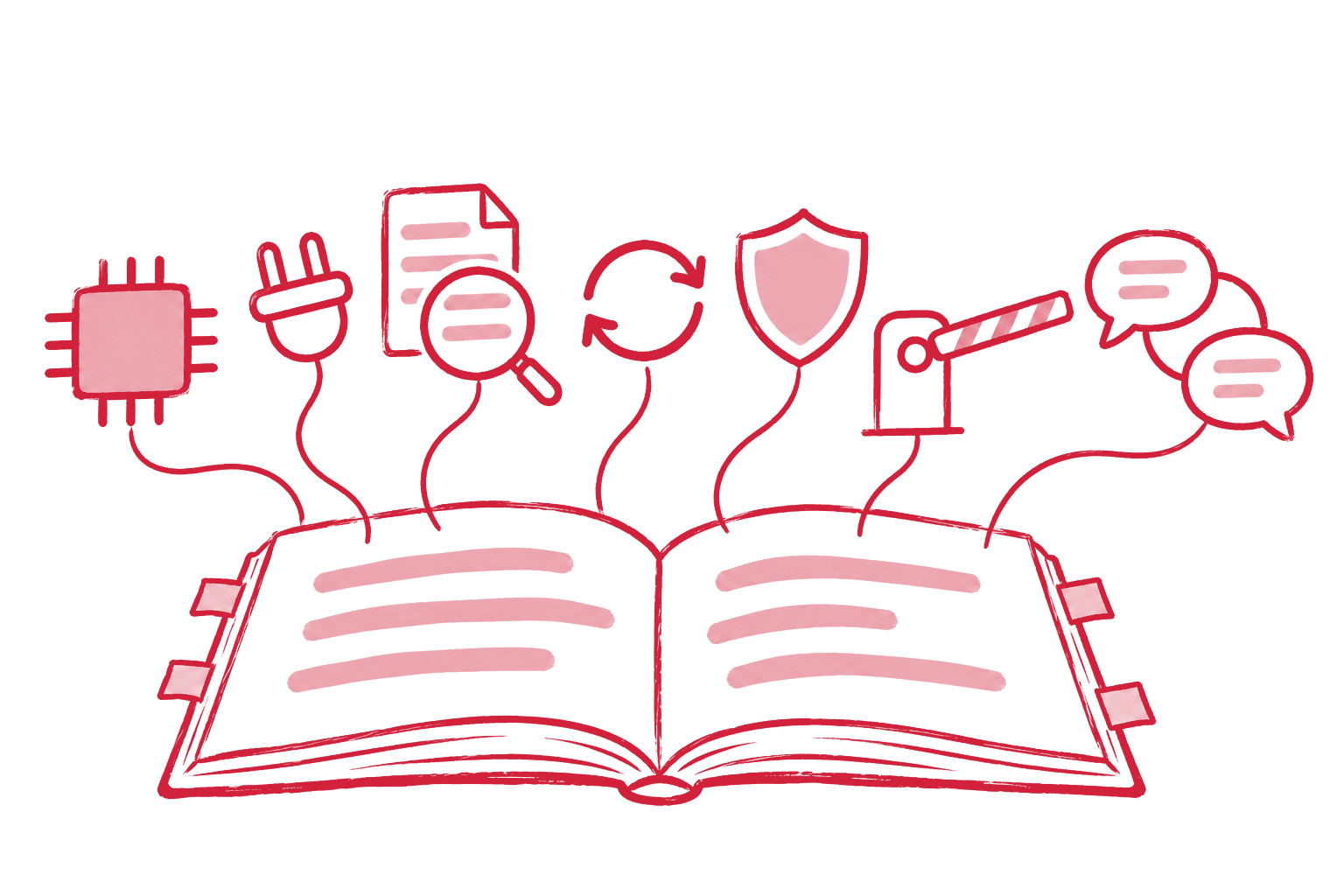
An AI agent glossary explains the terms that come up when people talk about AI agents: how an agent is built, how it reaches systems, and how to make it safe. The twenty terms below are grouped by topic, two sentences each, with what they mean for a business.
The basics
1. AI agent. A program in which a language model completes a task on its own by planning steps and calling tools. In a business that means entering orders, completing data, sorting emails. In depth: What is an AI agent?
2. Language model (LLM). The model that understands and writes text, such as Claude, GPT, or Gemini. It is the agent’s reasoning, but on its own it cannot do anything.
3. Agentic AI. The umbrella term for systems in which a language model plans steps and uses tools. It covers fixed workflows with model calls as well as autonomous agents.
4. Workflow. A process with fixed steps set by a developer upfront. For uniform tasks it beats an agent: faster, cheaper, testable. See AI agent, RPA, or workflow.
How an agent works
5. Harness. The software around the model: it builds the context, runs the loop, checks permissions and results. It decides quality more than the model does, see What is an agent harness?
6. Tool calling. Instead of text, the model outputs a structured call, such as “look up item 4711 in the PIM”, and the harness runs it. That is how an agent acts in other systems.
7. Context window. The amount of text a model can see at once: instructions, task, data, previous steps. What is not in it, the agent does not know.
8. Structured output. The model answers in a fixed format, such as JSON with given fields. A program can then process the result safely instead of interpreting text.
9. Subagent. A second agent with its own context, given a subtask by the first, such as research or a review. Separate contexts often catch each other’s mistakes.
How an agent reaches systems and knowledge
10. MCP (Model Context Protocol). An open standard through which an agent uses the tools and data of other systems, introduced by Anthropic in 2024. Several ERP vendors ship their own MCP servers, see MCP or API.
11. A2A (Agent2Agent). An open protocol through which agents from different vendors talk to each other, introduced by Google in 2025 and handed to the Linux Foundation. MCP connects agent and tool, A2A connects agent and agent.
12. API. A system’s interface for other programs. For fixed processes with many repetitions it stays the sturdiest route, even with an agent involved.
13. RAG (retrieval-augmented generation). Before answering, the agent finds the relevant passages in your documents and answers from them, with a source. In depth: What is RAG?
14. Embeddings. Number vectors that capture what a text means, so that similar content can be found even without the same words. They are the basis of search in RAG.
Safety and control
15. Human in the loop. A person approves before the agent does anything that touches money, customers, or master data. It is a fixed rule in code, not a request in the prompt.
16. Guardrails. Limits the harness enforces: which tools are allowed, which values are plausible, which content never goes out. They hold even when the model is wrong.
17. Prompt injection. An attack in which text in an email, a document, or a website slips the agent new instructions. Small permissions, approvals, and keeping data apart from instructions help against it, not a better prompt.
18. Evals. Test cases that measure how well an agent does its task, before and after every change. Without them nobody knows whether a new model or a new prompt is better.
Agents on the web
19. WebMCP. A proposal that lets a website offer its functions to agents in the browser as tools, such as “book an appointment”, instead of the agent hunting for buttons. The free AI Agent Readiness Check checks whether a page declares such tools.
20. llms.txt. A Markdown file at /llms.txt that tells a language
model briefly what a website contains and where. More in
What is an agent-friendly website?
The terms in one table
| Term | In one sentence |
|---|---|
| AI agent | A model that completes tasks with tools |
| Harness | Software that gives the model context, tools, and limits |
| Tool calling | The model calls a tool in a structured way |
| MCP | Standard: agent to tools and data |
| A2A | Standard: agent to agent |
| RAG | Answers based on documents found, with a source |
| Human in the loop | A person approves, by rule |
| Guardrails | Limits the harness enforces |
| Prompt injection | Instructions slipped in through data |
| Evals | Test cases that measure quality |
FAQ
What is the difference between an AI agent and a chatbot? A chatbot answers. An agent uses tools and completes a task in other systems until it is done or a person takes over.
Do I need MCP and A2A? MCP once agents should use several of your systems and those ship a server. A2A only when agents from different vendors should work together; in most companies that is not the case yet.
How do you protect an agent against prompt injection? With small permissions, approvals for everything important, and a harness that never treats data from emails and documents as instructions. A perfect defense inside the prompt does not exist.
AI agents that work inside your ERP, PIM, and CRM by these rules are what we build, at a fixed price.
Ask an AI about this post
