What is an MCP server? Explained simply
By Philipp Kant 3 min read
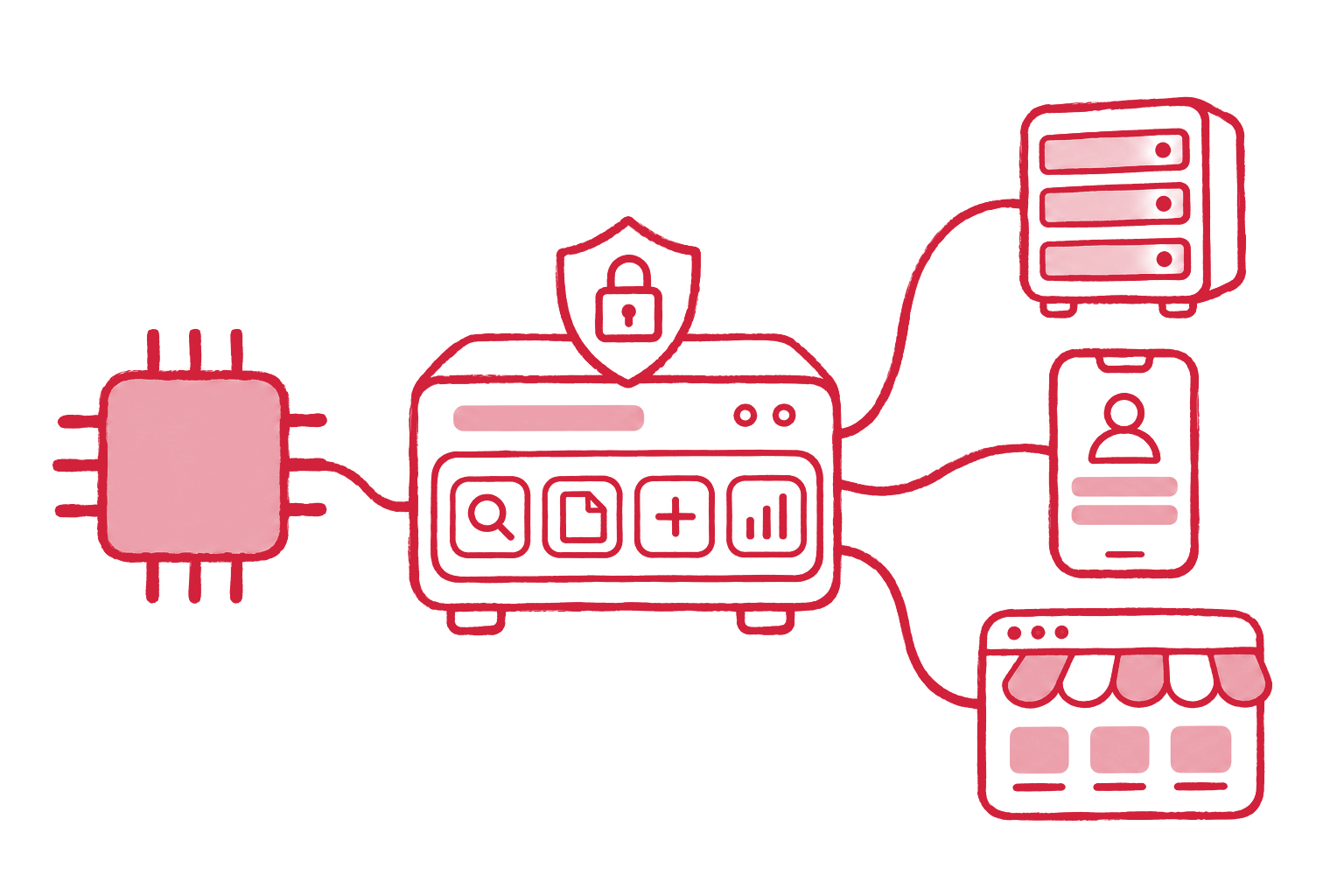
An MCP server is a program that exposes a system’s functions and data to AI agents through the Model Context Protocol (MCP). It tells an agent which tools exist, such as “find customer”, “check stock”, or “create quote”, with a description and parameters, and runs them when the agent calls them.
Anthropic introduced MCP in November 2024 and handed it to the Agentic AI Foundation under the Linux Foundation in December 2025. OpenAI, Google, and Microsoft support the standard. So an MCP server works with Claude, ChatGPT, Copilot, and most agent platforms.
How an MCP server works
| Part | Job | Example |
|---|---|---|
| Client | The agent or app that wants to use tools | Claude, ChatGPT, your own agent |
| Server | Offers a system’s tools, data, and templates | An ERP’s MCP server |
| Tools | Functions the agent can call | Find customer, create document |
| Resources | Data the agent can read | Item master, price lists |
| Prompts | Templates for common tasks | “Create the monthly report” |
The flow: the agent asks the server which tools exist, picks the right one for the task, calls it with parameters, and gets the result back. Whether a server runs locally on a machine or as a service on the network makes no difference to the agent.
Which systems have an MCP server
Since 2026 many vendors ship their own MCP servers, among them ERP systems such as Dynamics 365, Business Central, NetSuite, and Xentral (from its Business tier), automation platforms such as Activepieces, where every integration also serves as an MCP server, and assistants such as Le Chat that let you connect your own MCP servers. An overview of the ERP side is in MCP or API: how AI agents get into the ERP.
Building an MCP server
Where the vendor ships none, you build one:
- Define the tools: which functions should an agent use? A few clearly described tools beat many vague ones.
- Pick an SDK: official SDKs exist for TypeScript and Python, among others; a simple server takes hours.
- Connect to the API: the server calls the system’s existing interface and translates the result.
- Set permissions: generous for reading tools, writing only through checked paths and with approval.
- Test: with real questions to an agent before it goes live.
Security: MCP governs the call, not the permissions
The protocol says how an agent calls a tool, not whether it may. Three rules therefore belong in every production setup:
- Own permissions per tool: the server uses an account with exactly the rights it needs, not the admin account.
- Approvals in code: booking, ordering, deleting only after a person confirms, not just by instruction in the prompt.
- Vet servers: a third-party MCP server can carry tool descriptions that steer an agent into unwanted actions. Only connect servers from trusted sources.
What has to be built around the model is in what is an agent harness?.
FAQ
What is the difference between MCP and an API? An API is a system’s interface for programs. An MCP server usually sits on top of that API and describes it so that an AI agent can find it and call it correctly at runtime.
Do I need an MCP server for an AI agent? No. An agent can also call tools directly through code. MCP pays off when several agents or assistants should use the same system.
Is MCP secure? As secure as the server and its permissions. With its own account, approvals for writing tools, and vetted servers, it is fit for company data.
How do I find out whether my website is usable by agents? The free AI agent readiness check shows whether agents can operate your pages and whether forms are offered as tools through WebMCP. We build AI agents for business with MCP connections to ERP, PIM, and CRM, at a fixed price.
Ask an AI about this post
