Watch an AI agent triage your inbox
Paste a business email, or pick an example. The agent classifies it, pulls out the data, routes it to the right system, drafts the reply, and decides whether a person has to look first.
Your text goes to the Claude API for this one run and is not stored on kant.dev. Use the examples, or remove personal data before pasting real mail.
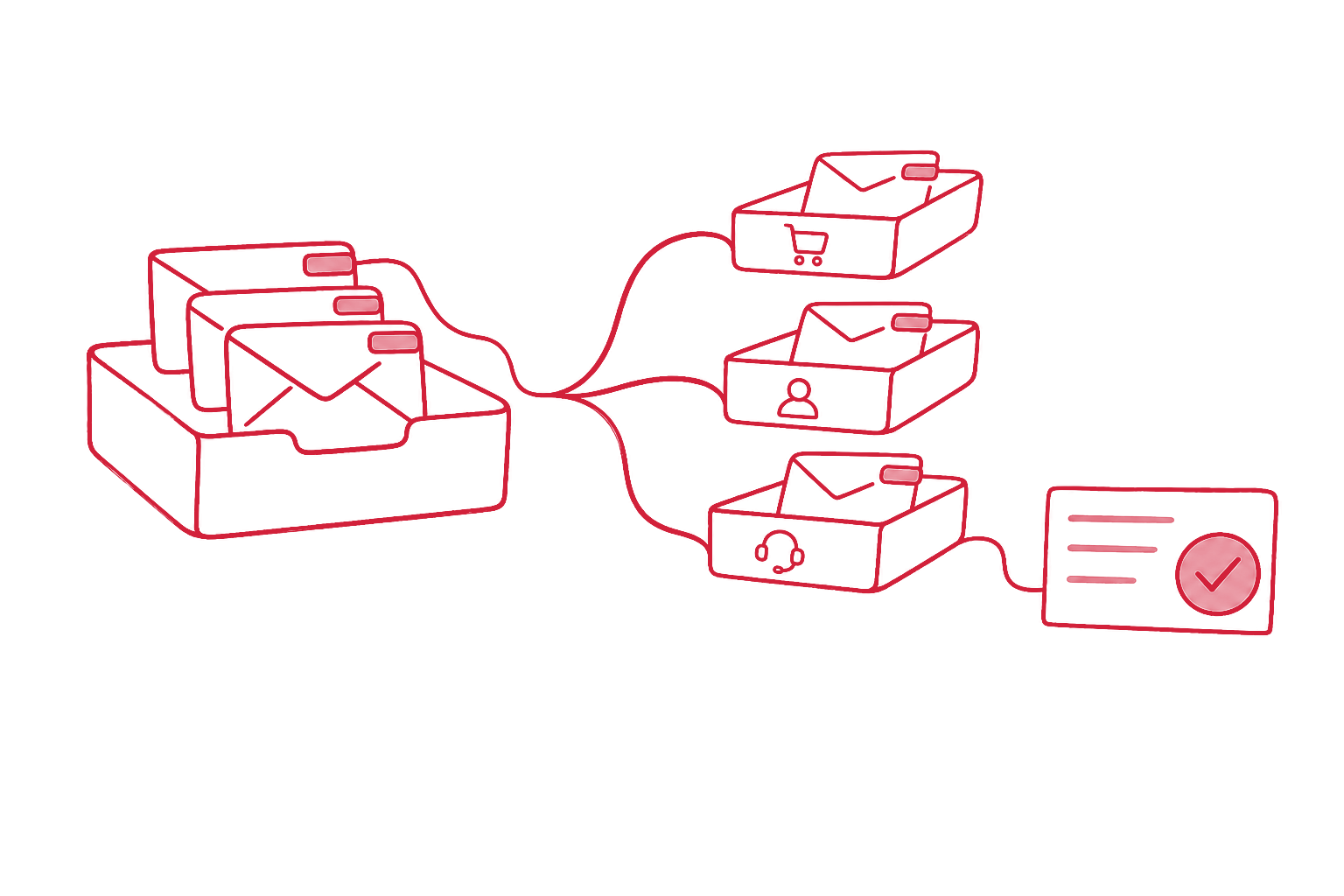
What the agent does
Read and classify
Intent (order, complaint, invoice, request, ...), urgency, and the sender’s mood, from the text itself.
Extract the fields
Names, companies, order and customer numbers, amounts, dates, and addresses, each with a confidence score. Nothing guessed.
Route and act
Which system owns the follow-up (CRM, ERP, support desk, accounting) and the concrete next steps an agent takes there.
Know when to stop
A fixed rule, not the model, decides when a person reviews first: angry senders, risk signs, complaints, legal requests, shaky extraction.
Your inbox, triaged before anyone opens it.
We build this agent into real mail flows: wired to your CRM and ERP, with your rules for what it may do alone and what a person approves.
From the blog
- Office AI agents: Cowork, ChatGPT Work, and more
Claude with Cowork and Duet, ChatGPT Work, Perplexity Teammates: what the new office AI agents do, what they cost, and where they still fail.
- AI agent, RPA, or workflow: which fits when
AI agents, RPA, and workflow automation compared: what each does, where each breaks, and why most business processes need all three.
- What is an AI agent? Definition and examples
An AI agent is a language model that completes tasks with tools. What it consists of, and how it differs from a chatbot and from a workflow.
- What is an agent harness?
An agent harness is the software around a language model that makes it act: context, tools, loop, permissions, checks. Why it matters more than the model.
- AI email triage: what the agent does
AI email triage: an agent reads incoming mail, extracts the data, routes it to CRM, ERP, or support, and drafts the reply. How it works, where humans stay.
- Structured intake is the first automation step
The highest-leverage automation step is making one recurring workflow start with structured intake: a form with explicit fields, not email or chat.
