Agentic AI vs generative AI: the difference
By Philipp Kant 4 min read
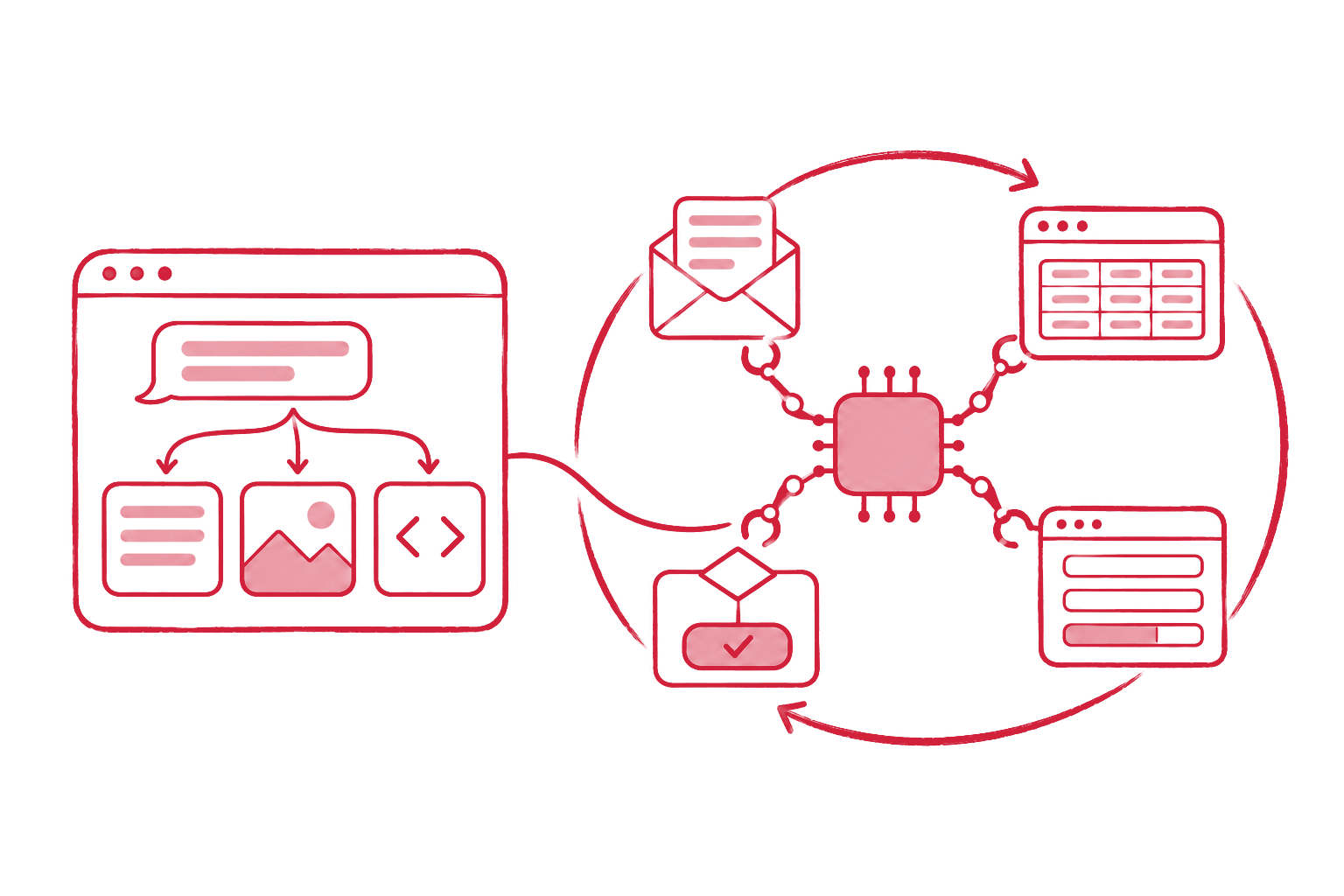
Agentic AI is AI that pursues a goal over several steps on its own and acts inside systems while doing it: reading emails, looking things up in the ERP, filling in forms, checking results. Generative AI, by contrast, creates content from a request, such as a text, an image, or code. The difference: generative AI answers, agentic AI gets it done.
The two are not opposites. Agentic AI uses generative AI at its core: a language model plans the next step, tools carry it out.
Agentic AI and generative AI at a glance
| Generative AI | Agentic AI | |
|---|---|---|
| What it does | Creates content | Completes a task |
| Trigger | A request (prompt) | A goal or an event, such as a new email |
| Steps | One: request, answer | Many: plan, act, check, continue |
| Access | What you put in | Systems via APIs, browser, files |
| Result | Text, image, audio, code | A finished case: booked, ordered, answered |
| Who checks | The person reading the answer | Rules, approvals, and a log |
| Examples | ChatGPT drafts an email, an image model creates a visual | An agent books incoming invoices into the ERP |
Generative AI creates content on request
Generative AI is a model that creates new content from an input. You write a request, the model answers. What happens to the answer is up to you: copy it, edit it, discard it.
Typical uses:
- Drafting text: emails, product descriptions, offers.
- Summarising: minutes, long documents.
- Writing code.
- Creating images and audio.
The limit: generative AI only has what is in the conversation. It does not look into your ERP and creates nothing there.
Agentic AI completes tasks over several steps
Agentic AI gets a goal, not a question. It breaks the goal into steps, calls tools, reads the results, and decides what comes next, until the task is done or a person has to decide.
An example, step by step:
- A supplier invoice arrives by email.
- The agent reads the PDF: supplier, amount, line items.
- It looks up the matching purchase order and goods receipt in the ERP.
- If all three match, it creates the booking as a draft.
- If the amount differs, it stops and hands the case to a person.
Step 2 is generative AI. Steps 3 to 5 make it agentic AI. How such an agent is built is in What is an AI agent?.
Agentic AI needs rules that generative AI does not
A wrong text gets read before it is sent. A wrong booking sits in the system. So agentic AI in production needs:
- Accounts with minimal rights: read-only where reading is enough; drafts only where a person approves.
- Approvals for risky steps: payments, orders above a limit, emails to customers.
- A log of every action: what the agent read, decided, and wrote.
- Fixed rules before the model: checks like “amount equals purchase order” run as code, not as a request to the model.
How the agent reaches your systems is settled by APIs, MCP servers, or the browser. The difference is explained in MCP vs API.
When generative AI is enough and when agentic AI fits
| Task | Generative AI is enough | Agentic AI fits |
|---|---|---|
| Answering an email | Draft a single reply | Sort, answer, and route hundreds of emails a day |
| Product copy | Write one text | Generate texts from PIM data and write them back to the PIM |
| Invoices | Summarise one invoice | Check invoices and create them as bookings |
| Research | Answer one question | Check sources weekly and report changes |
The rule of thumb: if a task comes up often, follows rules, and ends in a system, an agent pays off. Which processes those are for you is shown by the free KI-Potenzial-Check. Concrete examples are in 12 jobs for AI agents in ERP, PIM, and CRM.
FAQ
What does agentic AI mean? AI that acts as an agent: it pursues a goal over several steps and uses tools and systems while doing it.
Is ChatGPT generative AI or agentic AI? In the chat, ChatGPT is generative AI. With features that work on their own in a browser or in files, it shows agentic traits. An agent in a company is connected to your systems and works without a chat window.
Is agentic AI riskier than generative AI? It can do more damage because it acts. That is why minimal rights, approvals for risky steps, and a log belong with it.
Does agentic AI need its own model? No. It uses the same language models as generative AI. The difference lies in the tools, the rules, and the loop of planning, acting, and checking.
We build agents that work inside ERP, PIM, and CRM, with approvals and a log: AI agents for business.
Ask an AI about this post
